
Leasehold vs Freehold in Bali: Choosing the Right Ownership Structure for Investment in 2026
Bali Property Ownership in 2026: Leasehold, Freehold, and the Smarter Way Investors Are Structuring Deals
Understanding leasehold vs freehold in Bali is one of the most important—and often misunderstood—parts of investing in Bali property.
For Australian and international investors, the question isn’t just what to buy.
It’s:
“How can I legally and securely own property in Bali—and which structure actually protects my investment long-term?”
Because in Bali, ownership structure directly impacts your security, returns, flexibility, and exit strategy.
Can Foreigners Own Property in Bali?
Before comparing leasehold and freehold, it’s important to understand the legal framework.
Indonesia does not allow foreign individuals to directly own freehold land (Hak Milik).
Instead, foreign investors typically invest through:
Leasehold agreements (Hak Sewa)
Company structures (such as PT PMA)
Nominee or indirect arrangements (higher risk if not structured correctly)
This is why understanding how property ownership works for foreign investors in Bali is critical before entering the market.
What Is Leasehold Property in Bali (Hak Sewa)?
Leasehold is the most common and accessible ownership structure for foreign investors.
How Leasehold Works
You secure the right to use the land/property for a fixed period
The land itself is still owned by an Indonesian freeholder
At the end of the lease, ownership reverts unless extended
Typical Lease Terms
25 to 30 years (standard)
Often with extension options (e.g. +20–30 years)
Terms negotiated upfront in the contract
Advantages of Leasehold
Lower upfront investment compared to freehold
Simpler legal structure for foreigners
Widely used across Bali property transactions
Faster to acquire than complex company structures
Risks and Considerations with Leasehold
Depreciating asset over time (as the lease term reduces)
Extension terms are not always guaranteed unless clearly defined
Resale value tied to remaining lease length
Dependence on original contract conditions
These factors can significantly influence returns, especially in markets already impacted by villa oversupply in Bali.
What Is Freehold Property in Bali (Hak Milik)?
Freehold (Hak Milik) is the strongest form of land ownership in Indonesia—but it is restricted to Indonesian citizens.
Foreign investors can access similar control through structured approaches.
How Foreign Investors Access Freehold
Typically via:
A PT PMA (foreign-owned company)
Long-term legal structures that grant usage rights
Complex legal agreements requiring professional setup
Advantages of Freehold (Structured)
Greater long-term control over the asset
No fixed expiry date like leasehold
Potentially stronger resale positioning
Risks and Considerations with Freehold Structures
Higher setup costs and legal complexity
Ongoing compliance requirements
Regulatory risk if structures are not properly maintained
Greater reliance on legal advisors and correct structuring
Poor structuring in this area is one of the biggest risks highlighted in is buying property in Bali safe, particularly for offshore investors.
Leasehold vs Freehold in Bali: Key Differences
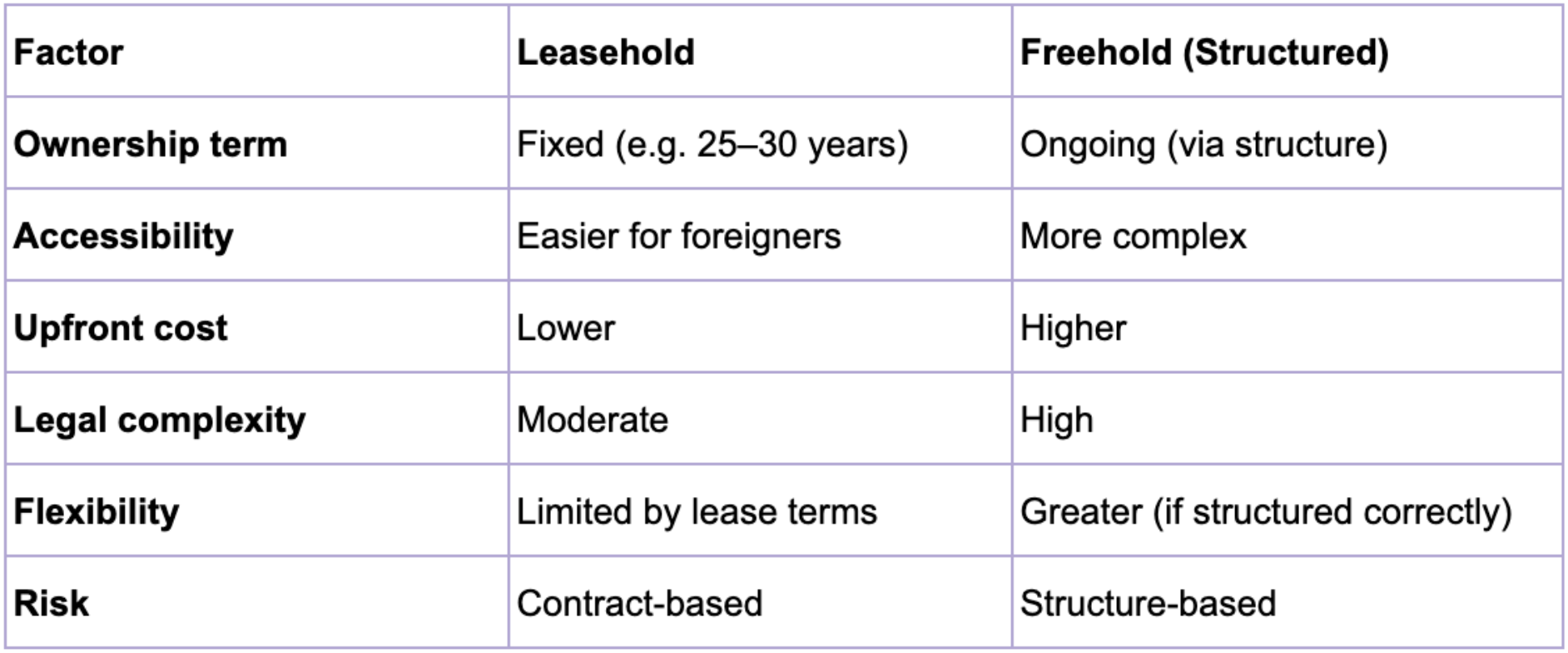
Key Considerations Before Choosing an Ownership Structure
When deciding between leasehold and freehold in Bali, investors should evaluate:
1. Lease Length & Extension Terms
Is the lease long enough to support your investment horizon?
Are extension terms clearly defined in the contract?
2. Legal Clarity & Documentation
Are agreements properly drafted and reviewed?
Is the ownership structure compliant with Indonesian law?
3. Exit Strategy
Will the asset be easy to resell?
How will lease duration or structure impact value?
4. Investment Objective
Are you buying for lifestyle, capital growth, or income?
Does the structure support your desired outcome?
The Risk of Getting Ownership Structure Wrong
Incorrect or poorly structured ownership can impact:
Security of your investment
Ability to generate income
Resale potential
Long-term value
In many cases, investors focus heavily on location and design—but overlook the structure behind the asset.
A Growing Shift: From Ownership Complexity to Structured Investment Models
As Bali’s market matures, many investors are stepping back and asking:
“Do I actually want to navigate ownership structures—or invest in a system that is already designed to perform?”
This is where a major shift is happening.
Instead of:
Navigating leasehold vs freehold complexities
Managing legal structures and compliance
Many investors are moving toward:
Professionally structured, managed hospitality investments
Assets where ownership and operations are already defined
Models designed to generate consistent income without direct involvement
Why Hotel & Resort Investments Simplify the Process
Compared to standalone property ownership, investing in hotels and resorts often provides:
Pre-defined legal and investment structures
Professional management from day one
No need to manage lease extensions or complex ownership setups
Income linked to overall asset performance—not a single property
This aligns with the broader shift toward cash flow-focused property strategies in Bali, where structure and simplicity are becoming key priorities.
Leasehold vs Freehold vs Structured Investment: A New Perspective
In 2026, many investors are reframing the decision:
Instead of asking:
“Should I choose leasehold or freehold?”
They are asking:
“What structure will give me the best combination of security, simplicity, and returns?”
For a growing number of investors, the answer is:
professionally managed hotel and resort investments
Final Thought: Structure Matters as Much as Location
Choosing between leasehold and freehold is critical—but it’s only part of the equation.
The true driver of success in Bali property investment is structure.
Because the right structure will determine:
How secure your investment is
How easily it performs
How simple it is to manage
How strong your long-term returns can be
Explore Smarter Ways to Invest in Bali
If you're exploring Bali property ownership, start by understanding how different investment structures compare.
Explore our complete Bali property investment guide to learn how leasehold, freehold, and hotel & resort investments differ—and which approach aligns with your goals.
Discover money management investment secrets and more information on the ins and outs of Bali property investment by accessing our educational video content.
Head to our main website to get started: balipropertyinvestment.com.au


